The bottleneck moved
I built a thousand-page site in about a week with a room of AI agents. The interesting part wasn't the speed.
A few of my better ideas arrive at 3am, and this was one of them — or at least the instructive kind. I'd spent a year quietly collecting AI tools: a design tool here, an image model there, a coding agent I mostly used for small chores. Each was useful on its own. What I'd never done was wire them together and aim the whole rig at a single goal to see what it could actually do.
So I gave myself a dare. Pick a niche I had no business competing in, build a real site for it, and use nothing but the tools already on my desk — no team, no budget, no off-page hustle. Three questions, really. Could programmatic SEO win in a crowded Vietnamese vertical? Could I get every tool I owned to behave like one machine instead of five toys? And the quiet one, the one the whole thing was actually about: where is my ceiling once the labor stops being the constraint?
The niche I landed on was tarot; I called the site SoiTarot. It's competitive, it's content-hungry, and — the part that matters — most of its demand is combinatorial. Twelve zodiac signs against twelve is a hundred and forty-four compatibility questions. Seventy-eight cards, each with its own meanings. Numerology, spreads, daily horoscopes, guides. A person writing by hand drowns in it. A system treats it as a for-loop.
The machine
The design came first, because a content farm that looks like a content farm is dead on arrival. I used Claude Design to build the whole system — color, type, components, motion — and to lock a single art direction I called Engraved Celestial Etching: deep navy, antique gold linework, the texture of an old astronomical plate. Then Higgsfield rendered every visual to that one spec — all seventy-eight cards, twelve signs, nine numbers — so that a thousand generated images still look like one hand made them. That consistency is the whole trick. Slop announces itself through variety. (Two follow-ups go deeper on this half of the build: designing the brand before the code, and motion under a Core Web Vitals budget.)
The build itself ran inside Claude Code, but not as one agent doing everything. I set up a small team of them — design, content, engineering, SEO — sharing a single .memory/ folder and a handoff protocol, so each one picked up where the last left off instead of starting cold. Bulk drafting went to the cheap, fast model; a slower, sharper one did the quality pass. The economics only work if you spend your good tokens where taste lives and your cheap tokens everywhere else.
The piece I'm proudest of isn't any single tool. It's the fence I built around them. Every page had to clear a CI gate before it could ship: a banned-words list that killed deterministic fortune-telling claims, a rule that enforced natural Vietnamese over translated-sounding filler, a structural check for the SEO scaffolding. On deploy, IndexNow pinged the search engines automatically; JSON-LD, an llms.txt, and per-page metadata went out with every build. I even gave the site a bylined author — a name, a face, a point of view — because search rewards a person and treats an anonymous content farm like exactly what it is.
A week to live
From the 3am note to a live deploy was about a week. The commit history tells the honest version of the pace: a couple hundred commits, almost all of them front-loaded into the first stretch, then a sharp drop to nothing. I didn't ship slowly here, which is unusual for me — but the thing about a machine is that once it's tuned, you mostly get out of its way.
By the time it went live it was generating pages at a scale I couldn't have hand-written in a quarter: the full compatibility matrix, the whole deck, the daily horoscopes refreshing on their own, numerology and spreads and guides stacked on top. Not thin doorway pages, either — each one genuinely different, gated by the same quality checks, structured for both search engines and the AI answer boxes that increasingly sit above them.
What it's doing now
Here is where I have to be careful, because this is the part people lie about.
It's a few weeks live, so the third-party tools barely register it yet — which is exactly what makes the shape worth showing. In its first month the site went from zero to about 170 ranking keywords, and the curve isn't a step, it's a compounding climb.
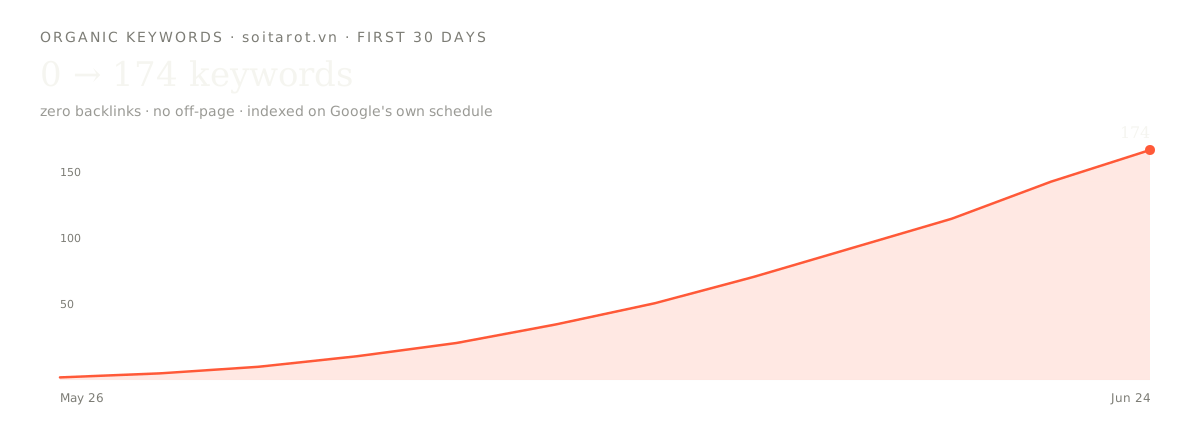
Don't trust the traffic figure any tool hands a site this young; it reads 29 visits a month, which badly undercounts what the real analytics show. The honest leading indicator is the keyword footprint, and the footprint is building fast. What's more telling is where those keywords sit.
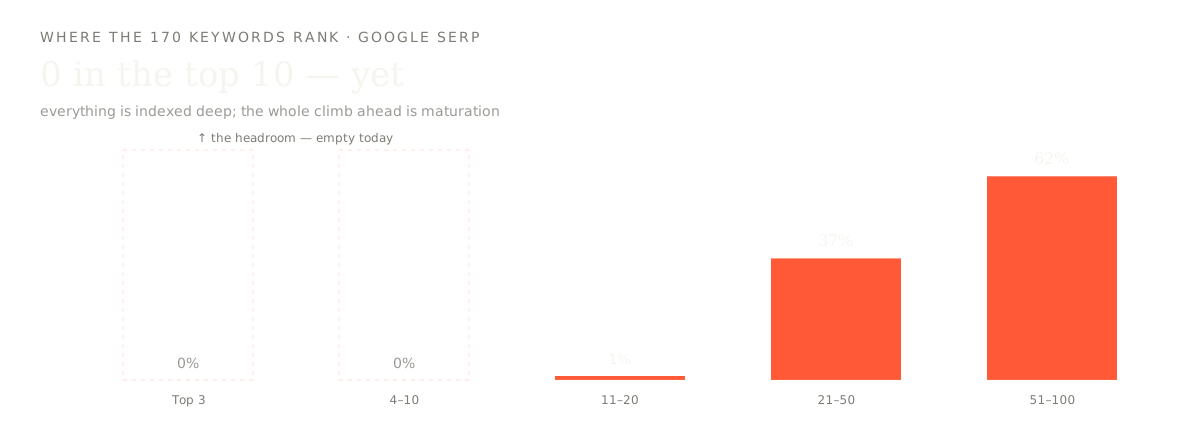
Nothing has reached the top ten. Read that as upside, not failure. The single biggest query in the niche — a hundred-thousand-searches-a-month head term — is already ranking, at position eighty-one. The next, forty thousand a month, sits at thirty-one. They're on the board, just deep. As a domain ages, deep rankings drift upward, and on a programmatic site that drift happens across thousands of pages at once.
The rest of the picture is as bare as the design was rich: zero backlinks, no authority score to speak of, no entity work, almost entirely informational intent. I've done none of the off-page hustle you're supposed to do. Google is indexing it anyway, steadily, page after page, on its own schedule.
A week ago I stopped touching it entirely. On purpose. I wanted to know whether it grows without me in the room, or whether I'm the thing holding it up. So far it grows without me.
When you can generate a thousand pages and a thousand images on demand, the scarce resource stops being pages or images. It becomes the judgment to keep them from being garbage — and the discipline to let the system run.
Where this goes
I'll put a stake in the ground, because a prediction you can check later is the only honest kind. This is the trajectory without the amplification layer — no links, no E-E-A-T push, no entity building — just the content compounding as Google matures the rankings it has already handed out.
| Horizon | Ranking keywords | What should break through |
|---|---|---|
| 3 months | ~500–900 | first low-competition long-tail reaching page 1–2 |
| 6 months | ~1,500–3,000 | clusters of card and compatibility pages landing in the top 10 |
| 12 months | ~4,000–8,000 | long-tail matured; real organic traffic in the thousands a month |
The ceiling in that table is deliberate. The long tail — thousands of low-competition card meanings and compatibility pairings — climbs on content and age alone. The head terms won't. That hundred-thousand-a-month query reaches page two on merit and then stalls, because page one for a prize like that is bought with authority: links, a real entity, the E-E-A-T signals I haven't built. That layer is its own project, for another time. Everything in the table is the floor — what the machine does on its own while I'm out of the room. The amplification is upside I simply haven't spent yet.
The bottleneck moved
That's the real finding, and it surprised me more than the traffic did.
For my whole career the constraint was labor. There was always more to make than hours to make it in, so the people who shipped most won. That world is ending. I made a polished design system, a thousand on-brand images, and a four-figure pile of pages, alone, in a week. The making was nearly free.
What wasn't free was everything around the making. Deciding what good looked like. Encoding that decision into a gate a machine couldn't talk its way past. Choosing the niche, the angle, the one art direction that held the whole thing together. Knowing when to stop. The CI gates turned out to be the actual product — taste applied once, at the fence, instead of a thousand times at the keyboard.
So the answer to my quiet question — where's my ceiling now — isn't "how much can I output." Output is solved. The ceiling is whether I know what's worth making, and whether I can build the rails that hold a machine to that standard while I sleep. That's a more uncomfortable ceiling, because you can't out-work it. You can only out-think it.
I won't oversell the experiment. It's a few weeks old. The curve could flatten next month; Google could decide AI-built sites are a wall it wants to build, and a lot of this could age badly. But the question I started with was how far does AI-built SEO actually go, and the honest, early, zero-tricks answer is: further than I expected, and it's still going. That's not a conclusion. It's a reason to keep watching.
The lamp's still on. I just stopped feeding it.
The build, in pieces: